Fools of Time by Northrop Frye
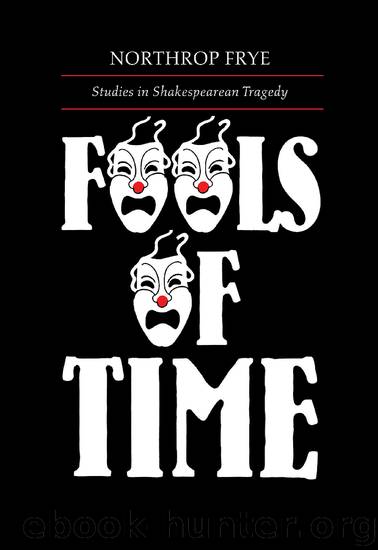
Author:Northrop Frye
Language: eng
Format: epub
ISBN: 9780802016713
Publisher: University of Toronto Press
Published: 2016-07-24T16:00:00+00:00
Little world
of man:
The tragedy
of isolation
Little world of man: The tragedy of isolation
In Shakespeare’s tragedies certain moral issues are involved, and often, particularly in the histories and the Roman plays, our moral sympathies are divided. But in many of the greatest tragedies there is no division of moral sympathies at all. Whatever sympathy we may have for Iago, Edmund, Macbeth, or Claudius is dramatic, not moral. And yet the feeling of Shakespearean tragedy is authentic, in contrast to the less authentic version of tragedy that we call melodrama, where we feel impelled to applaud the hero and hiss the villain. Titus Andronicus seems to us less authentically tragic than Hamlet: the plot of Hamlet is slightly less violent, but not so much so as to make that the crucial difference. In authentic tragedy we participate in the action: we condemn Iago and Macbeth because they are what they are and yet have succeeded in making themselves extensions, for a moment, of ourselves. Melodrama leans to the moral and conceptual, and tries to identify us with a heroism we admire and separate us from a villainy we detest. Melodrama thus tends to find its emotional tragic focus in the punishment of the villain, and our reaction to that is primarily: “Oh, the difference from me!”
Thus melodrama appeals to emotions akin to those aroused in watching a public execution. The action of The Spanish Tragedy is watched by a personified Revenge and the ghost of Don Andrea, a former lover of the heroine, Bel-imperia. Bel-imperia is in love with someone else when the play begins, and one wonders if the reason for Don Andrea’s pleasure in the action is resentment that everybody has so completely forgotten about him. But no: the reason is that he just likes to see bloody things happening:
Horatio murdered in his father’s bower;
Vile Serberine by Pedringano slain;
False Pedringano hanged by quaint device;
Fair Isabella by herself misdone;
Prince Balthazar by Bel-imperia stabbed;
The Duke of Castile and his wicked son
Both done to death by old Hieronimo;
My Bel-imperia fallen as Dido fell,
And good Hieronimo slain by himself:
Aye, these were spectacles to please my soul!
Occasionally we feel that a tragedy has manipulated its action in the direction of horror, just as a comedy may manipulate its action in the direction of a happy ending. The Cardinal, in Shirley’s play of that name, is an unattractive but well-realized character for four acts, but when he goes on into attempted rape and poisoning we feel that the integrity of his character has been sacrificed to a blood-and-thunder conclusion. Such manipulation is melodramatic rather than tragic. Again, at the end of Titus Andronicus Aaron’s fate is carefully spelled out for us: he is to be buried up to his waist in earth until he starves to death. His response to this is most satisfactory: a regret that he had not done ten thousand more evil deeds. The conclusion is tragically less authentic than the threat to torture Iago to death at the end of Othello, because, coming where it does in that play, it is the utter futility of revenge on Iago that most impresses us.
Download
This site does not store any files on its server. We only index and link to content provided by other sites. Please contact the content providers to delete copyright contents if any and email us, we'll remove relevant links or contents immediately.
4 3 2 1: A Novel by Paul Auster(12382)
The handmaid's tale by Margaret Atwood(7759)
Giovanni's Room by James Baldwin(7334)
Asking the Right Questions: A Guide to Critical Thinking by M. Neil Browne & Stuart M. Keeley(5765)
Big Magic: Creative Living Beyond Fear by Elizabeth Gilbert(5759)
Ego Is the Enemy by Ryan Holiday(5422)
The Body: A Guide for Occupants by Bill Bryson(5085)
On Writing A Memoir of the Craft by Stephen King(4937)
Ken Follett - World without end by Ken Follett(4726)
Adulting by Kelly Williams Brown(4569)
Bluets by Maggie Nelson(4549)
Eat That Frog! by Brian Tracy(4528)
Guilty Pleasures by Laurell K Hamilton(4443)
The Poetry of Pablo Neruda by Pablo Neruda(4100)
Alive: The Story of the Andes Survivors by Piers Paul Read(4025)
White Noise - A Novel by Don DeLillo(4006)
Fingerprints of the Gods by Graham Hancock(3999)
The Book of Joy by Dalai Lama(3978)
The Bookshop by Penelope Fitzgerald(3844)
